Description
Product Catalogue Printing in Sialkot: A Complete Guide for Export-Focused Manufacturers
When a foreign buyer, military procurement officer, or wholesale distributor evaluates a Sialkot-based supplier, the printed catalogue is often the deciding artifact. It is not a marketing accessory — it is the first tangible evidence that your brand can operate at the precision, scale, and documentation standards international trade demands. A weak, generic, or amateurishly printed catalogue signals risk. A professionally bound, correctly coded, properly finished catalogue signals readiness.
For manufacturers, OEM/ODM factories, and brand owners exporting out of Sialkot — whether you produce embroidered badges, woven patches, shoulder boards, sports gloves, leather apparel, or surgical instruments — this guide explains exactly how product catalogue printing works in Pakistan, what separates digital from offset production, what paper and finish choices signal quality at each price tier, and how to commission a catalogue that delivers measurable business returns.
Why Sialkot Manufacturers Cannot Afford to Skip the Catalogue
Sialkot’s sports goods industry exported approximately USD 430 million in FY2025 and continues to compete aggressively for global leadership against regional manufacturing hubs in Vietnam and China through 2026 Grand Review – Sialkot Sports Goods Export Strategy. According to the same analysis, reclaiming global market share requires Sialkot exporters to upgrade their value chain beyond production into branding, certification, and buyer-facing collateral.
Simultaneously, the shift toward OEM and private-label partnerships for international clubs and federations continues to accelerate Sports-Gen – Sialkot Sports Industry. Every OEM conversation begins with the supplier sending a catalogue — not a PDF, not a website link, but a printed artefact that the buyer can hold, mark up, and circulate internally to procurement committees.
The downstream reality is this: a catalogue that is functionally coded, sector-grouped, translated, and printed on premium stock consistently shortens sales cycles and reduces repeated quoting work. Exporters who omit this step are forced to renegotiate every specification via email, while those with a clean catalogue lock down orders on the first or second exchange.
Who Needs a Printed Product Catalogue in Sialkot?
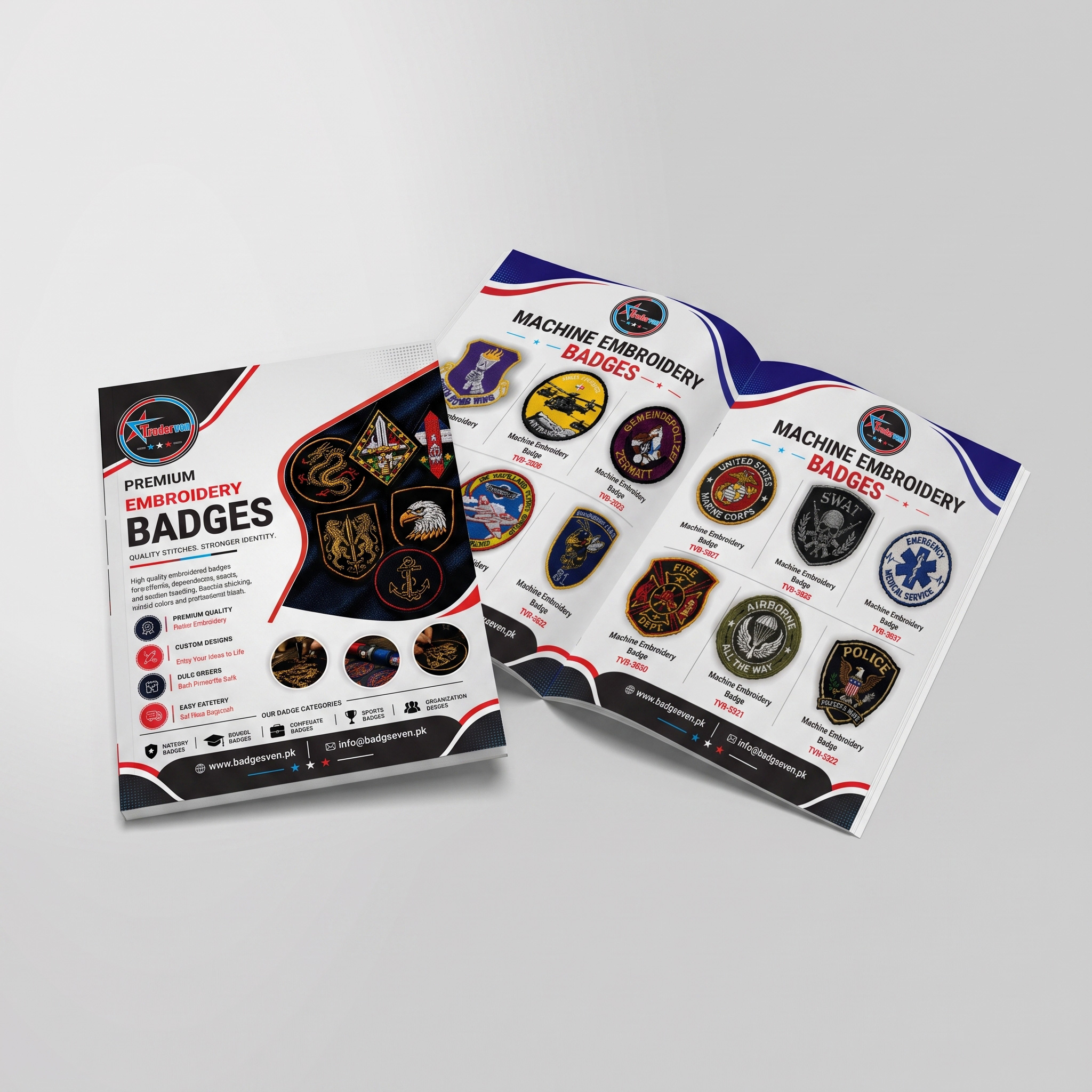
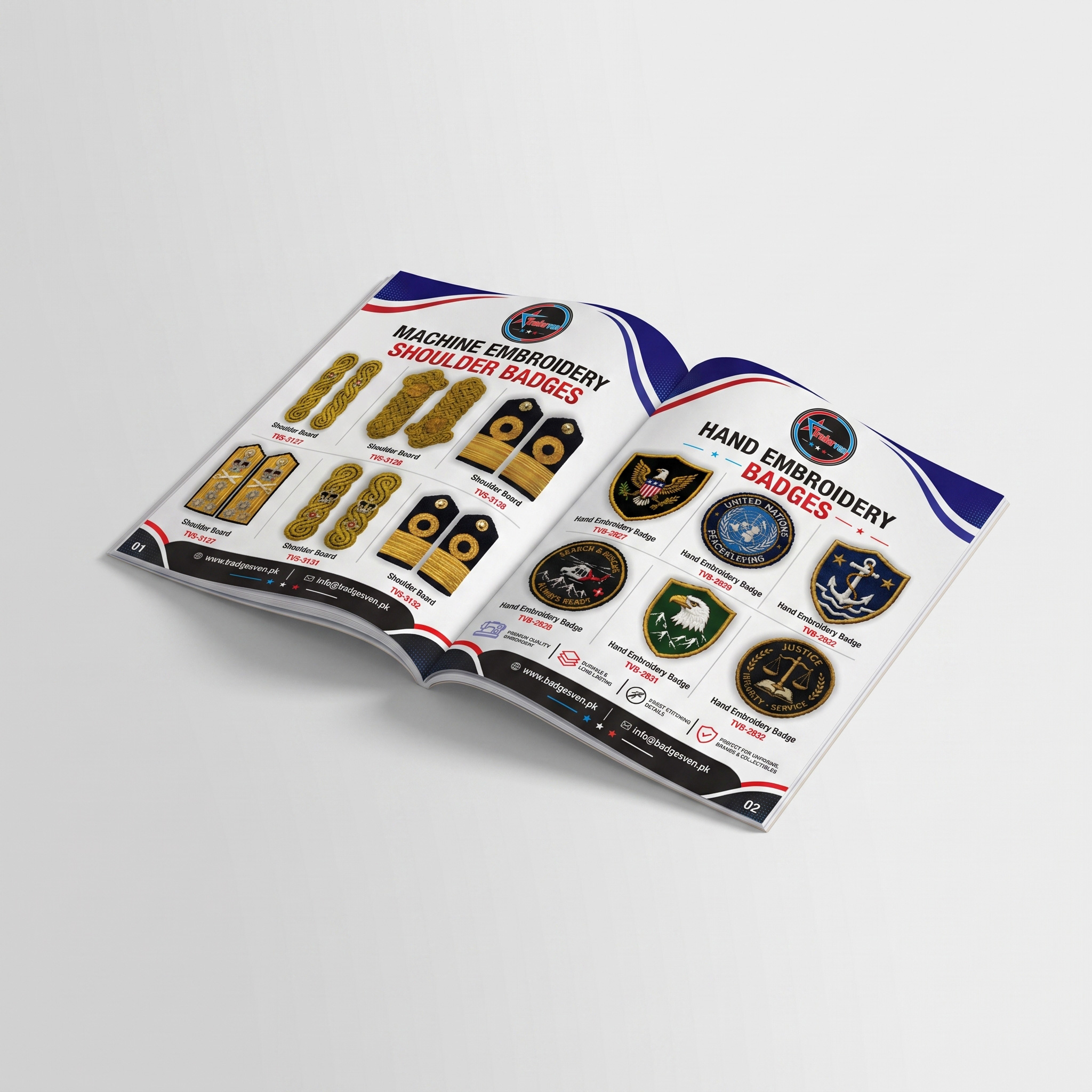
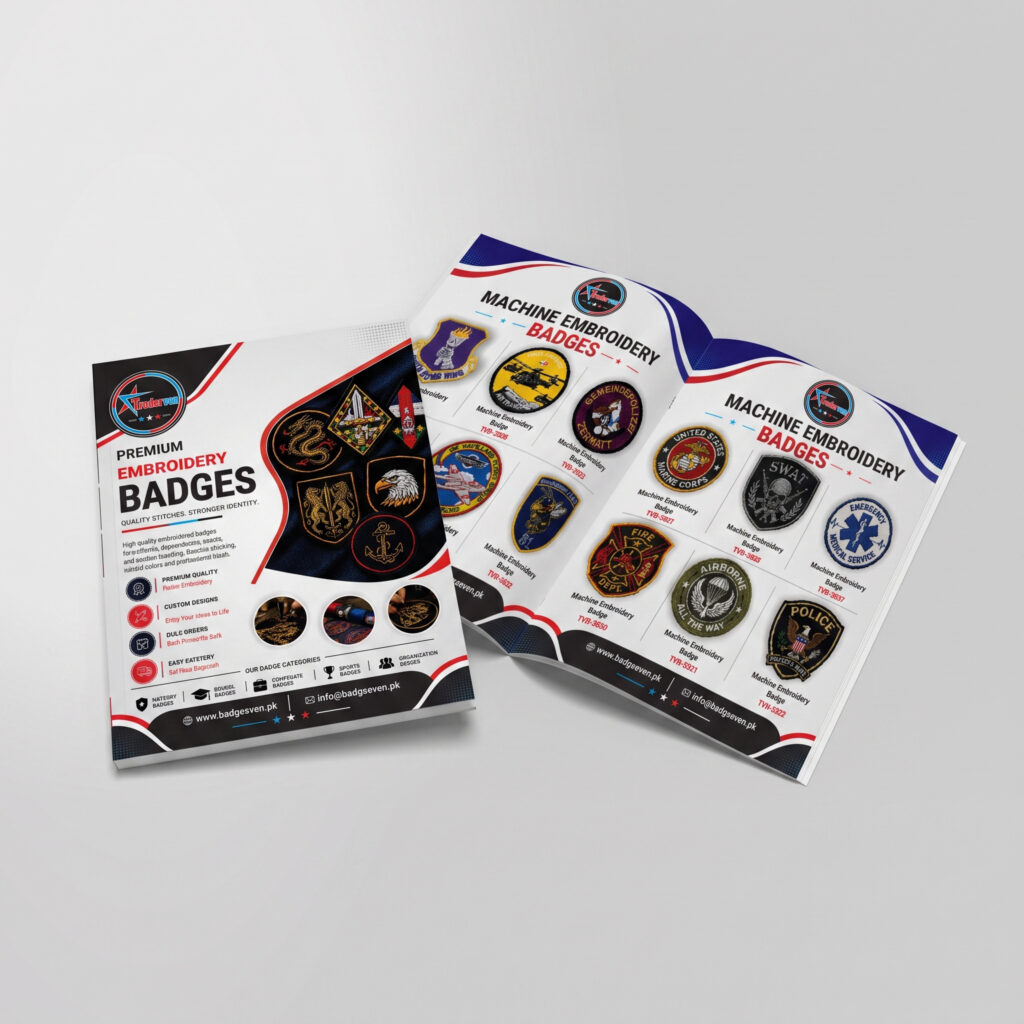
The reference artwork you provided is an excellent example of an embroidery badges catalogue — but the same production logic applies across nearly every exporting category in Sialkot:
- Military and law enforcement insignia manufacturers — rank patches, shoulder boards, hand-embroidered crests with departmental coding
- School and educational uniform brands — crested badges grouped by school level, region, and curriculum
- Corporate identity suppliers — company logo patches for hospitality, energy, banking, and government sectors
- Sports merchandise and teamwear brands — federations, clubs, academies, and event merchandise programs
- Apparel and leather accessory exporters — gloves, jackets, bags, belts with finish and material variations
- Promotional product distributors — give-away and corporate gifting programmes
- Surgical and dental instrument exporters — specification-heavy product lines requiring detailed documentation
Each of these categories benefits from a sector-specific catalogue rather than a generic product list. The cheapest catalogue is rarely the most profitable one for the buyer relationship.
Digital vs Offset Catalogue Printing — When to Use Each
Choosing between digital and offset production is the first technical decision, and it depends almost entirely on your run quantity, deadline, and content variation needs.
Digital Catalogue Printing
Digital printing builds each page directly from the digital file — no plates, no make-ready, no minimum imposition. This makes it the correct choice for:
- Short runs from 1 to 1,000 copies
- Campaigns requiring variable data per copy (personalised buyer names, custom pricing tiers, regional variation)
- Time-sensitive launches where 24–72 hour turnaround matters
- Sample and proof runs before committing to bulk offset production
- Trade fair giveaways where final artwork is still being refined
Per-unit cost is higher than offset at quantity, but the absence of plate and setup charges means the break-even point arrives much sooner. Pakistan’s digital printing capacity has grown significantly, and same-day short-run services are now widely available in Sialkot and across major cities Royal Printers – Planning a Cost-Effective Trend in Digital Printing.
Offset Catalogue Printing
Offset produces each colour plate separately and prints the full run in continuous passes. This is the production method for catalogs intended to function as master distributor references for an entire sales year:
- Bulk runs from 500 to 50,000+ copies
- Pantone-accurate colour matching for brand consistency
- Heavier paper stocks (157gsm, 170gsm, coated art paper) handled without warp
- Lower per-unit cost once setup is amortised — bulk offset in Pakistan commonly starts around PKR 80–180 per copy depending on size, pages, and finishing choices Megapack – Offset Printing Pricing Reference
- 7–10 working days standard lead time including plate-making and setup
For OEM catalogues, distributor master books, and annual reference artefacts, the offset method remains the industry standard because the per-copy economics and finish quality only become compelling at scale.
Paper Stock, Finishes, and Binding Options
A catalogue is judged by the buyer before any text is read. The weight of the paper, the finish on the cover, and the integrity of the binding all communicate brand position. Below are the practical options Malik Art offers at each tier.
Inner Paper Stocks
| Paper | Weight | Use Case |
|---|---|---|
| Coated art paper | 80gsm | Budget short-run catalogues |
| Matte art paper | 100gsm | Standard mid-tier publications |
| Gloss art paper | 128gsm | Photo-heavy product spreads |
| Premium art paper | 157–170gsm | Flagship catalogues, distributor master books |
Cover Stocks and Treatment
| Cover Option | Effect |
|---|---|
| 250gsm art card | Functional entry-level cover |
| 300–350gsm art card | Standard mid-weight premium feel |
| Textured cover stock | Tactile sophistication for artisan or heritage brands |
| Kraft cover | Eco-positioning for sustainable brands |
| Soft-touch matte lamination | Velvety anti-fingerprint premium finish |
| Spot UV logo on cover | Selective gloss highlighting of brand mark |
| Gold or silver foil on cover | Metallic stamp for crest-style or luxury brands |
| Embossed brand name | Raised effect for tactile brand recall |
Binding Methods
| Binding Type | Best For | Limitation |
|---|---|---|
| Saddle-stitch (stapled) | 8–32 page brochures, trade fair handouts | Not suitable for thick catalogues |
| Perfect bound (glued spine) | 40+ page corporate catalogues | Pages do not lay fully flat |
| Wire-O binding | Line-sheets, training manuals, references | Industrial-looking |
| Spiral bound | Reference documents, presentations | Less retail-presentation-suitable |
| Hard-bound cover | Annual reports, signature editions | Highest cost per copy |
For badges and insignia catalogues — where buyers often want to mark and annotate individual product spreads — Wire-O or Spiral binding allows the catalogue to lay completely flat, which is operationally important during quotation discussions.
Sector-Specific Layout Logic
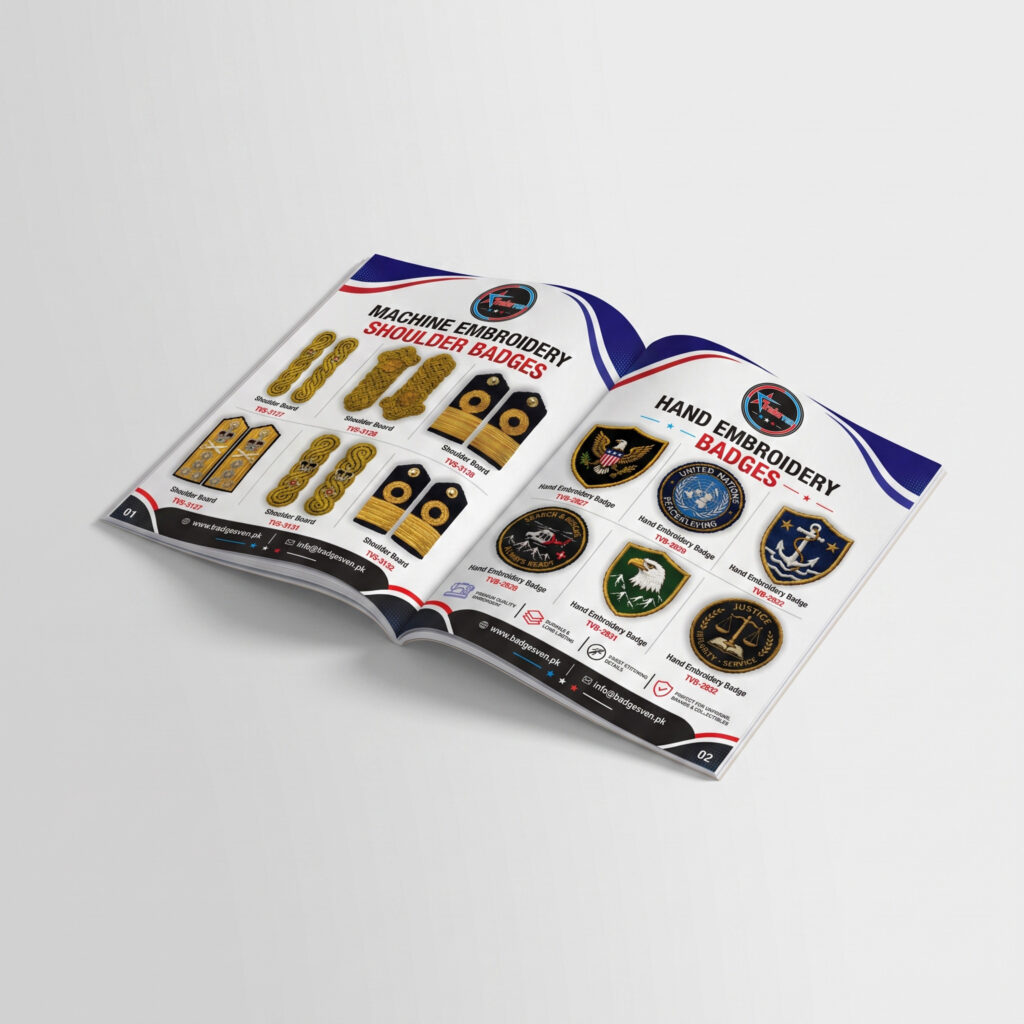
The reference catalogue artwork demonstrates several layout strategies worth replicating in any export-facing publication:
1. SKU coding as a structural system. Every badge carries a code (TVB-XXXX for hand embroidery, TVS-XXXX for shoulder boards). These codes become the cross-reference between the catalogue, the website, the price list, and the buyer’s purchase order. Removing SKU coding from a catalogue collapses its function as a transactional document.
2. Category segmentation with visual hierarchy. “Machine Embroidery Shoulder Badges” sits on a dedicated spread with its own bold title treatment, distinct iconography, and consistent photography style. Category-level spread transitions allow buyers to skip sections irrelevant to their inquiry without losing the overall catalogue narrative.
3. Trust signals in the footer. Quality certification marks — ISO-9001, CE, customer satisfaction icons, secure payment icons — anchor the bottom of each spread. For exporters, these certifications are decisive during procurement screening and should always appear on every spread, not just the cover.
4. Contact accessibility. The reference footer repeats website, email, and phone on every spread rather than only on the back cover. This is intentional — buyers reviewing a catalogue often stop at a single spread before circulating it internally. The contact details must be present at every page-of-interest.
5. Cover value propositions with iconography. The reference cover front prints four short value statements — Premium Quality, Custom Designs, Bulk Pricing, Fast Delivery. These act as the buyer’s first-scan answer to the question “why should I engage further.” They are not slogans — they are immediate competence statements.
Production Workflow at Malik Art
For buyers commissioning a catalogue, the production workflow is designed to minimise revision cycles and protect delivery deadlines:
- Requirement scoping — Quantity, page count, paper tier, binding method, finish level, deadline
- Design handover or build — Either supply print-ready files or commission our in-house studio to construct the layout from product photography and specifications
- Digital soft-proof — Low-resolution PDF review via email or WhatsApp, with annotation
- Optional physical sample — One-copy print on the actual paper and binding for tactile approval before production run
- Plate preparation or digital queue — Offset plate-making or direct-to-press digital queueing
- Production run — Full quantity with in-line colour control and registered finishing
- Binding and finishing — Lamination, spot UV, foil stamping, embossing, and final assembly
- Quality control sampling — Page-by-page random pull check before pack-out
- Dispatch — Pakistan-wide courier or international DHL/FedEx with tracking
Bilingual and Multilingual Catalogue Production
Pakistan’s primary export markets increasingly require localised documentation. Malik Art regularly produces bilingual layouts in the following combinations:
- English + Arabic for Saudi Arabia, UAE, Kuwait, Qatar, Oman, Bahrain, Iraq, Jordan
- English + French for North and West Africa, francophone Europe
- English + Spanish for Latin America, Spain, and growing Central American markets
- English + Russian for CIS countries and Central Asia
- English + Chinese for selected PRC-based OEM buyers
When commissioning a bilingual catalogue, factor in 10–15% additional design time for justified text layout, increased page count, and bilingual typography pairing (typically Latin + Arabic or Cyrillic).
Trade Show Catalogue Timing
Most catalogue projects are tied to a trade fair deadline. The following 2026–2027 calendar covers the principal exhibitions where Sialkot exporters typically distribute printed catalogues:
| Exhibition | Sector | 2026–2027 Dates | Source |
|---|---|---|---|
| 3P Pakistan Expo | Plastics, Printing, Packaging | 3–5 September 2026, Lahore | PlasPrintPack |
| DPS World Pakistan | Digital Printing & Signage | August 2026, Karachi | DPS World |
| SME Sports Goods Cluster Showcase | Sports goods | 24–26 January 2026, Expo Centre | SME Expo |
| PrintPak Expo | International Printing & Packaging | 12–14 January 2027, Lahore | PrintPak Expo |
For trade fair attendees, digital short-run catalogues delivered within 72 hours are often the only practical option when final product photography or pricing is still being updated close to the event.
Price Bands, MOQ, and Lead Times Summary
| Variable | Digital | Offset |
|---|---|---|
| Minimum order quantity | 1 copy | 500 copies |
| Lead time | 1–3 working days | 7–10 working days |
| Per-copy cost (typical, A4 24pp) | PKR 250–450 | PKR 80–180 |
| Variable data per copy | Yes | No |
| Pantone match accuracy | 90–95% | 98%+ |
| Best suited for | Trade fairs, samples, proofs | Distributor master books, annual editions |
International pricing is offered in USD with DHL and FedEx shipping. Tracking is provided with every shipment.
Frequently Asked Questions
1. Do I need SKU codes and prices inside the badges catalogue? Yes. Export buyers and wholesale distributors expect every SKU to carry a unique product code and typically require a dedicated price-list section as the last 4–8 pages of the catalogue.
2. Can you print bilingual catalogues in Arabic, French, Spanish, or Russian? Yes. We routinely produce bilingual layouts in these languages with properly justified typography and bilingual page numbering systems for regional distribution.
3. Which binding is best — saddle-stitch, perfect bound, spiral, or Wire-O? Saddle-stitch is optimal for 8–32 page brochures. Perfect binding gives a professional retail appearance for 40 pages and above. Spiral or Wire-O is the correct choice when the catalogue must lay fully flat — typical for line-sheets, training manuals, and any document the buyer will mark up physically.
4. Can QR codes be added to a printed catalogue? Yes. QR codes can be printed on any page or the back cover, linking to your website, WhatsApp Business catalogue, or product video. We ensure all codes are tested for scannability at production scale.
5. Do you provide design services or only printing? Both. Malik Art’s in-house design studio can build a complete catalogue from your product photography, specifications, and brand guidelines. Alternatively, you may supply print-ready InDesign or PDF files.
6. Do you ship internationally? Yes. We ship worldwide via DHL and FedEx with delivery typically within 3–7 working days. Tracking is provided at dispatch.
7. Can a 100-copy short run be produced for an imminent trade fair? Yes. Digital printing supports 100-copy trade fair runs within 1–3 working days, including saddle-stitch binding and standard lamination.
8. What file format should I supply if I already have artwork? Print-ready PDF/X-4 with 300dpi imagery, 3mm bleed on all sides, and CMYK colour space. InDesign, Illustrator, or layered Photoshop files are also accepted with their source assets.
Call to Action — Commission Your Catalogue
If your business exports from Sialkot — whether embroidered badges, woven patches, shoulder boards, sports gloves, leather goods, garments, or any other product category — and your current sales collateral does not include a professionally printed catalogue, you are leaving measurable revenue on the table.
Malik Art has been designing and producing export-grade printing since 1954 and supports Pakistan’s exporters with catalogue production, woven labels, hang tags, leather patches, packaging boxes, and complete brand-presentation systems under one roof.