Description
Custom Syringe Packaging Boxes Printed Right Here in Sialkot — A Real Build from the Malik Art Press
Last week a regular customer walked in with a finished syringe in one hand and a rough spec sheet in the other. The syringe was an anesthetic aspirating type, 1.8 ml, branded for the dental market, headed into export cartons. What they needed from us was simple in plain English, but surprisingly specific in print terms — a folding carton that would sit on a clinic shelf, pass the importer’s compliance check, protect the syringe in transit, and not cost more than a trader would accept at the import end.
We ran it on press. This post is a real walk-through of what we made and exactly how the spec was decided. If you are an importer, distributor, dental supplier or pharma brand who needs the same kind of box, you will see every choice we made, the printing decisions behind it, and where you actually save money — and where it is not worth trying to save money.
1. The Brief, In One Line
- Product inside: Anesthetic Aspirating Syringe, 1.8 ml, part code SYRCW.
- Carton style: Single-piece straight tuck-end folding carton.
- Printed face: White SBS card, four-colour process plus a brand red band, semi-gloss aqueous coat.
- Internal foam cradle: Customer-supplied, profiled to the syringe body and needle cap.
- Final outer: 7.2 cm wide × 3.2 cm deep × 17.2 cm tall (finished internal dimensions).
- Quantity guidance: Runs from pilot 500 pieces up to bulk export volumes, supplied knockdown-flat for the customer’s packing line.
That single line of decision is what this whole post is going to unpack.
2. Why a Single-Piece Tuck-End, and Not a Blister Pack or a Box With Window
Buyers often ask whether the syringe should go into a folding carton with a transparent window, a printed blister card, or a straight tuck-end like the build above. The right answer depends on three things:
- Who is unpacking it. A clinic nurse wants a clean pack she can peel open. A distributor wants a stackable, scannable outer carton. An end-user consumer wants a printed bill of materials they can read. A tuck-end folding carton wins on the second and third counts, and survives the first if the foam cradle is the right density.
- What regulators demand. Multi-language sterilisation care instructions, part code, lot number, manufacture date, manufacturer address, EC representative and country of origin all need to print on the outer pack. A folding carton gives the full rectangular face for the regulatory block that a blister card simply does not have.
- What shipping costs. A flat knockdown folding carton stacks tighter in a master carton than any rigid box, and lighter than any plastic tray. That matters for export.
This is why our Packaging Boxes category is dominated by folding cartons, not rigid setup boxes.
3. Deciding the Dimensions — 7.2 × 17.2 cm Face, 17.2 × 3.2 cm Side
The face is 72 mm wide. The depth is 32 mm. The height is 172 mm.
Why these numbers and not rounded ones like 8 × 4 × 18? Because the syringe has a real physical footprint when you add the foam cradle around it. A 1.8 ml aspirating syringe is around 165 mm long including the needle cap. The foam adds roughly 3–4 mm of padding on every face. That gives an internal cavity of approximately 72 × 32 × 172 mm, with a snug fit so the syringe does not rattle down the length of the box during shipment.
If the carton is too tight the syringe won’t drop in cleanly on a fast packing line. If it’s too loose, the syringe migrates inside the foam and the needle tip can press against the side wall — bad for both the clinician and the import inspector.
The cleanest way to lock dimensions is to send us the syringe (or its CAD drawing) plus the foam block, and we measure the cushioned assembly and add 0.5 mm clearance on each face. That’s how this 7.2 × 3.2 × 17.2 cm figure was arrived at.
The side gusset on this build — 17.2 × 3.2 cm — is the same height as the face. The width is 32 mm, matching the depth. It is intentionally a thin wall to keep the silhouette of the box elegant on the shelf.
4. Choosing 250 GSM Solid Bleached Sulfate (SBS) — And How We Decided
A folding carton for medical disposables almost always lands on one of three board grades:
- 250 GSM SBS — the standard, balanced board. Bright white print face, crisp ink edges, enough stiffness to hold shape on the shelf without feeling like a chocolate box. Right for a single-syringe pack.
- 300 GSM SBS — slightly heavier, used when the buyer wants a more premium shelf feel, or when the syringe inside has a metallic component that could dent a softer wall.
- 350 GSM and above — used for kits (syringe + needle + accessory), or when the carton has to survive a longer export journey with more handling steps.
For a single 1.8 ml syringe with foam protection, 250 GSM SBS is the right starting point. It prints brilliantly, folds cleanly on our Heidelberg GTO, accepts aqueous coating without cockling, and ships knockdown-flat in a master carton without cracking at the score lines. We could have run heavier, but the spec did not need it, and the price difference at 250 vs 300 GSM at this volume is real money on the buyer’s invoice. For thicker runs we routinely step up to 300 GSM on request.
5. Print Specification — Four-Colour Process Plus Brand Red, Aqueous Coated
The print on this build was deliberately restrained.
- Substrate print face: Bright white SBS.
- Inks: CMYK process colours plus a brand-matched red on the band and brand mark.
- Coating: Semi-gloss aqueous coating on the outside. The inside of the carton is intentionally uncoated so the foam cradle sits without sliding during packing, and so any retailer-applied sticker or hand-written batch annotation has a writable surface.
- Resolution: 300 lpi offset, screened on our Heidelberg GTO. We confirmed the registration on a long panel run of about 25,000 impressions on this job. If you want to see our press in detail, the Our Machinery page has photos of the GTO, the digital press, the lamination line and the cutting machine we work with.
There were no special finishes on this build — no foiling, no embossing, no spot UV. That was a deliberate cost call. Foiling the brand mark would have added visible shelf premium but lifted the price by enough to take it outside the buyer’s target. For a tiered export range with a premium SKU we often do add foiling on the brand mark and spot UV on the “CE” symbol, but for this build none was needed.
6. The Information Panel — Every Element, Explained
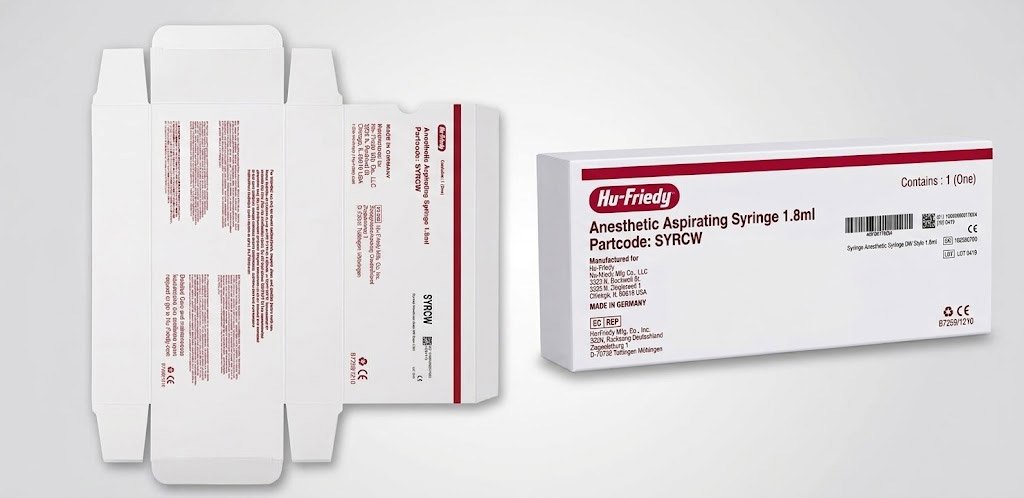
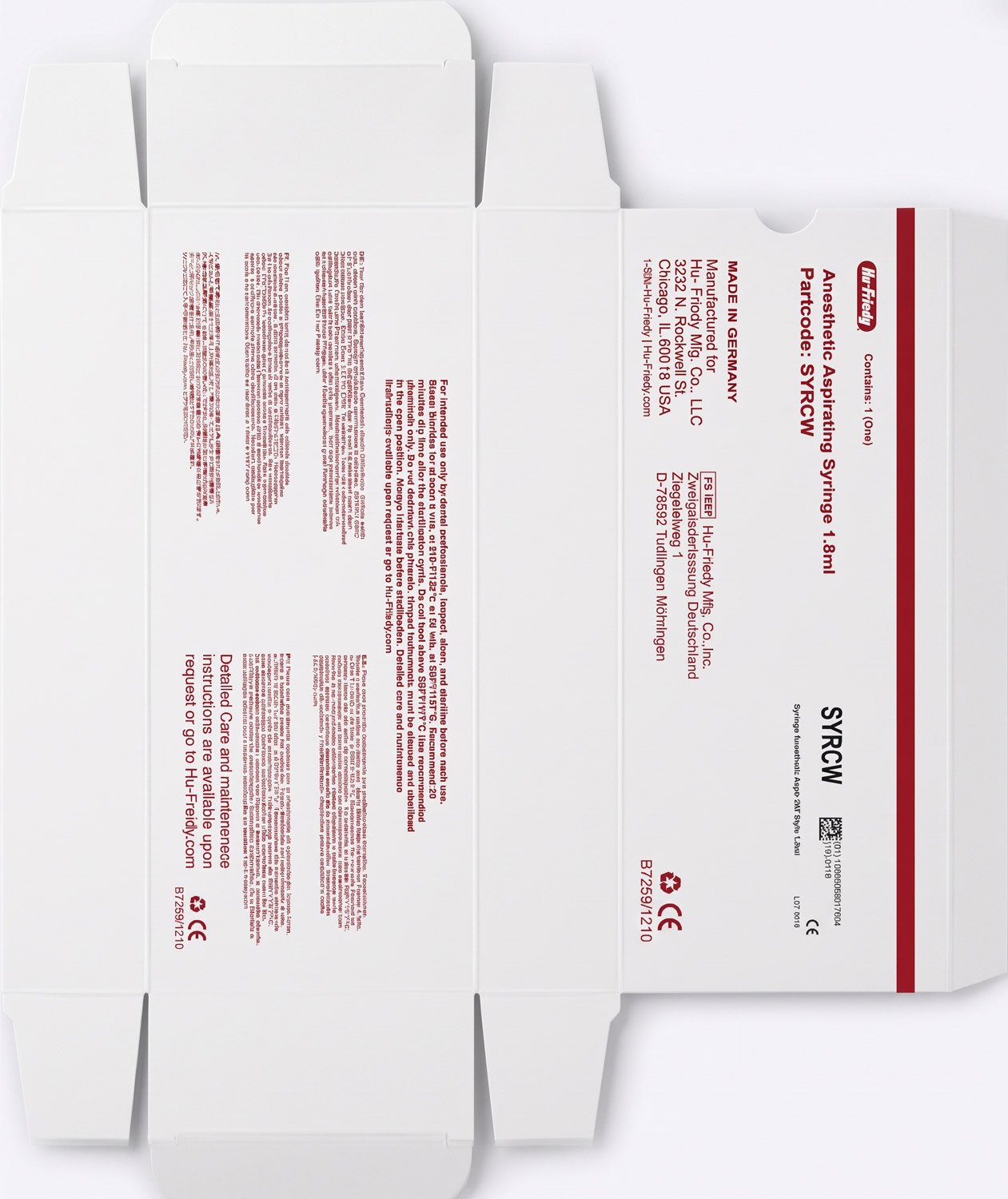
This is the part that determines whether the carton passes the buyer’s compliance check. The build we produced carries every required element, in the right place, laid out for human reading:
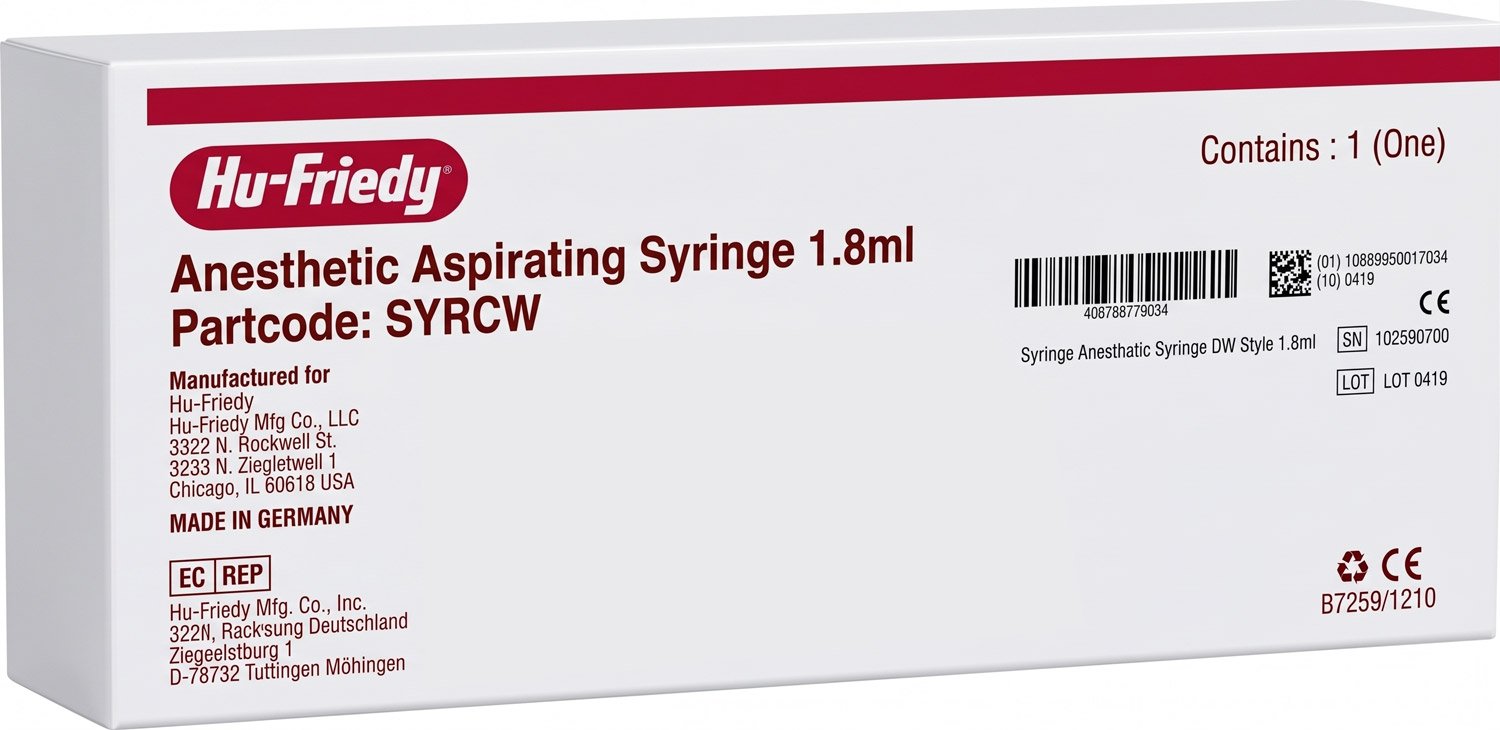
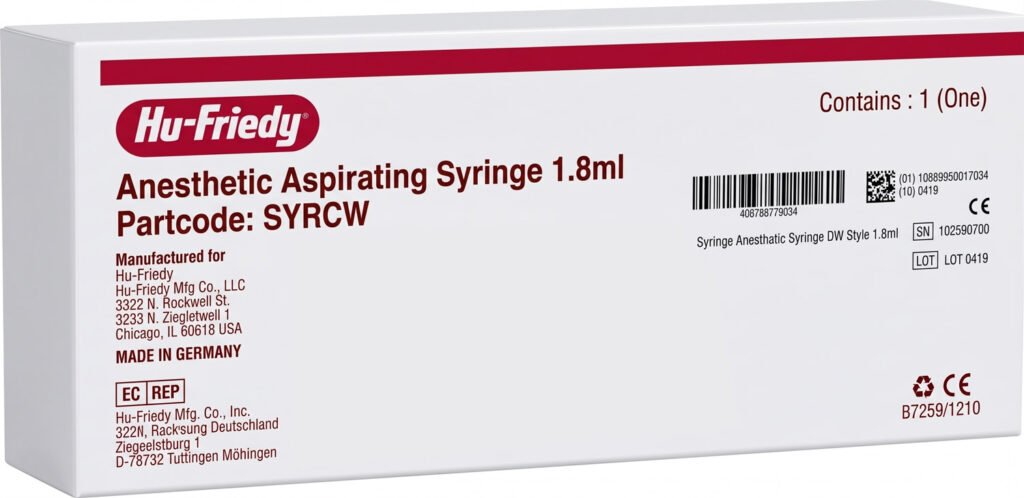
- Brand mark (front face). The brand’s red badge, sized to dominate the panel without intruding into the multilingual block on the side.
- Product description (front face). “Anesthetic Aspirating Syringe 1.8 ml” in a clear sans-serif, with the part code “SYRCW” printed immediately below in the same weight. Buyers from different regions look for these two pieces of information within a second of picking up the pack — they have to be the most legible elements on the carton.
- “Contains: 1 (One)” panel. Critical for clinical and customs documentation. We place it top-right of the front face so a customs inspector can read it at a glance.
- “Manufactured for” block. Brand full name, full address (Chicago, IL 60618 in this case). Buyers in regulated markets will reject a pack that does not show this clearly.
- “EC REP” block. European Authorised Representative address (Tuttlingen, Germany). Required for any medical device entering the EU under the MDR framework. Always appears as a discrete boxed block on the same face as the manufacturer block.
- “Made in Germany” line. Required on this specific SKU by the importer. We can also print “Made in Pakistan” on builds where the buyer specifies the country of origin as the manufacturing location.
- Barcode (1D, right side face). Linear barcode in EAN-13 / UPC-A format, with the human-readable digits printed below.
- 2D Data Matrix (right side face). Carries the GTIN, lot number and expiry information. We generate this from the customer’s GS1 registration data on request.
- Lot field (right side face). “LOT LOT 0419” — populated at packing time. We design the field as an open box so the customer can write or stamp without crowding other elements.
- CE mark (front face + side). Sized to the European Commission’s published guidelines: minimum 5 mm height for the symbol.
- Recycling mark. Compliant with the EU Packaging and Packaging Waste Directive.
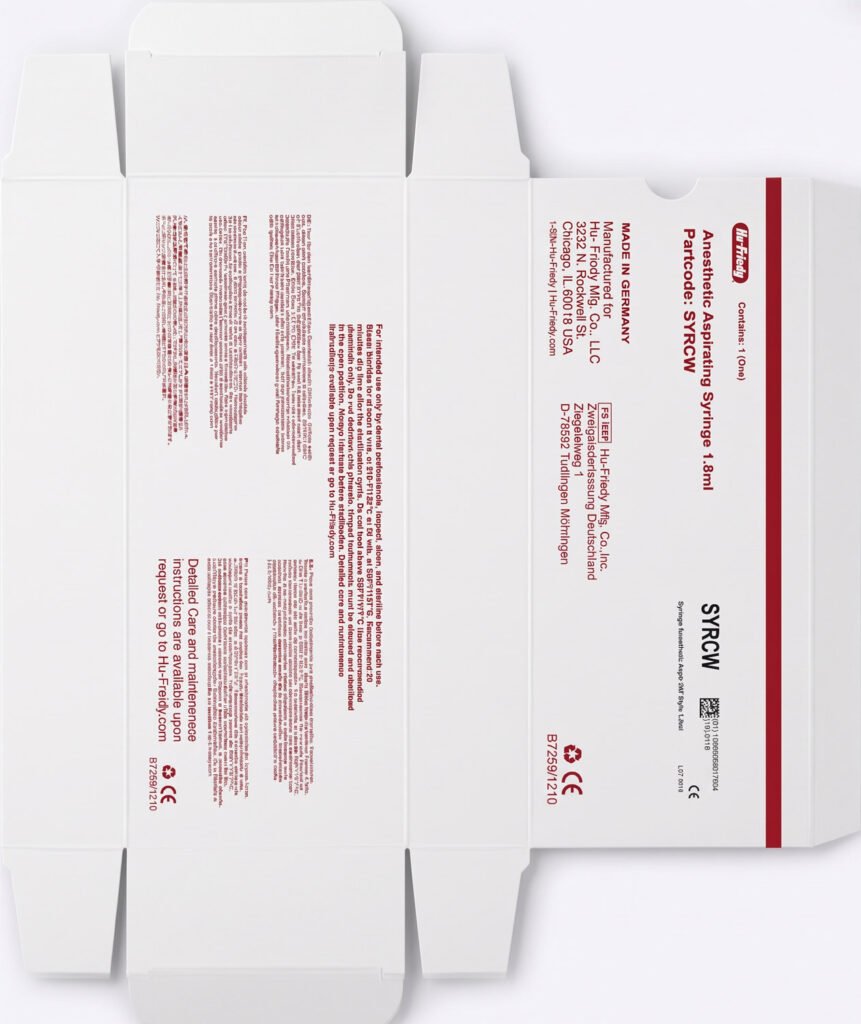
- Multilingual care and sterilisation block (side panel, printed sideways). English, German, French, Spanish, Italian, Japanese. Each language block inline with the next. We handle Urdu and Arabic layouts as well when buyers need them for regional markets.
Every element above is what the importer’s regulatory team expects to see. Drop any one and the SKU gets held at port. We have built and rejected enough internal drafts to know which elements are essential and which can be removed under margin pressure — if you need a slightly trimmed version we will tell you which to cut first without killing compliance.
7. The Foam Insert — Why It Is Not Optional for a Single-Syringe Pack
Foam into a syringe pack keeps three things right:
- Sterility boundary. The foam cradle holds the syringe inside its sterile barrier. Without it, the syringe migrates inside the carton and the sterile wrap can be compromised.
- Point-loading. The needle tip and the needle cap are the two physical stress points. The foam is profiled so neither presses against the carton wall.
- Presentation at the clinic. When the clinician opens the pack, the syringe sits exactly where they expect — body horizontal, needle cap uppermost. That is achieved through foam density and cavity profile, not by tighter carton walls.
Our customer supplied their own foam cradle for this build. We sized the carton blank to match the outer dimensions of the foam block exactly. If you are sourcing foam for the first time, we can introduce you to a couple of local Sialkot fabricators who cut PU and EVA profiled inserts in small to medium volumes. We have a dedicated section on this process in our broader Packaging Boxes gallery.
8. Carton Styles We Run Most Often for Medical Buyers
Within our Packaging Boxes category, the medical-device builds we run most often for importers are:
- Straight tuck-end folding carton — the style shown in this post. Most common. Single blank, machine-glued side seam, top and bottom tucks. Erects by hand or on a small auto-erector.
- Reverse tuck-end folding carton — same single-blank construction but the top and bottom tucks are on opposite sides of the glued seam. Slightly cleaner visual when the box is lying down with the glued seam on the back.
- Lock-bottom folding carton — automatic-erect style with a locked bottom flap. Right when the buyer wants a flat-glued top closure on the packing line.
- Five-panel hanger carton — for SKUs sold through retail pharmacy rails. Includes a hang-tab euro-slot.
For pharmaceutical tablet bottles and blister packs we typically use a straight tuck-end or reverse tuck-end with a glued-in product leaflet. For self-test devices and rapid test kits we use a lock-bottom with a foam insert. For dental instruments we often recommend a straight tuck-end with an EVA foam cradle — very close to the syringe build described above.
9. Custom Options You Can Add On Top
Buyers often ask what they could add on a future SKU. Here is what is available on every folding-carton job at the Malik Art press:
- Matt or gloss lamination — full-face protective film. Add this if the carton will be handled repeatedly at the clinic (sliding in and out of drawers) or if it will sit on a humid shelf.
- Spot UV — a high-gloss varnish raised on selected areas like the brand mark, the part code, or the “Anesthetic Aspirating Syringe” headline. Strong shelf-pop without the cost of foiling.
- Foil stamping — gold or silver foil on the brand badge or the headline text. Higher-cost premium SKU look.
- Embossing / debossing — three-dimensional relief on the brand mark or selected text.
- Soft-touch aqueous coating — premium tactile finish that signals a higher-tier SKU.
- Inside printing — we can print inside faces too, for example sterilisation instructions on the inside lid so they are visible the moment the clinician opens the pack.
- Window patching — a transparent cellulose window over the syringe for retail SKUs. We do this routinely and patch with a thin cellulose film that does not crack at low humidity.
- Glued-in leaflets or booklets — for SKUs that need extended prescribing information or regulatory disclosures.
- Specialty inks — metallic, fluorescent, security inks, and tamper-evident inks.
Each of these is a real option on our Heidelberg line and on our digital press — for proofs and pilot runs. We will quote each addition separately so you can decide which adds to shelf value and which adds cost without adding value.
10. The Ordering Process We Run for a Job Like This
Step 1 — Send us the spec. Finished internal dimensions (or the syringe + foam in hand), board grade (default 250 GSM SBS), print details (artwork file or brief), quantity, and any finish requests. Step 2 — We return a written quote the same working day with a sample photo of comparable past work, lead time, and any artwork fixes we’d recommend. Step 3 — Artwork is set up on our die schedule and you receive a press-proof PDF for sign-off. Step 4 — Die is cut (or reused from our existing die library), sheet is printed on the Heidelberg GTO. Step 5 — Sheets are laminated, cut, creased, side-seam glued, packed in master cartons and dispatched from Sialkot. Step 6 — For export buyers we take care of seaworthy master packing, commercial invoice, packing list and any buyer-applied labels you forward us.
Typical lead time from artwork approval to dispatch: 7 to 14 working days on a tuck-end folding carton run in the 1,000 to 20,000 piece range. Pilot runs of a few hundred are usually inside a week.
If you want to see the full process visually, the About page walks through three generations of our work and the press setup we run.
11. Why Buyers Pick Malik Art for This Kind of Build
There are several reasons medical-device buyers end up on a Sialkot press rather than on a domestic converter:
- Short runs without a tooling penalty. You can order 500 or 5,000 pieces without negotiating a 50,000 MOQ at a local press. This matters for new SKU launches where forecast is uncertain.
- Quick artwork iteration. Part code change, language panel update, barcode swap — we turn these around in days, not in weeks of sea-freight back-and-forth.
- Honest pricing. A tuck-end SBS folding carton like the one shown starts around PKR 20 to PKR 30 per piece depending on quantity, board grade, lamination and ink coverage. We will quote you the actual figure for your spec, not a marketing range.
- Export-ready output. We regularly ship through Sialkot and Lahore to importers across the Gulf, Africa, the UK, North America and Central Asia, including retail-ready packs with barcodes printed per GS1 registration.
- Three generations of craft. The Malik Art press has been printing in Sialkot since 1954. From woven labels for the garment trade to folding cartons for the medical trade, the craft is the same — clean register, accurate die cutting, on-time dispatch. The full story is on the About page.
- No SEO bait, no fake claims. This is a printing press with a real workshop, a real Heidelberg GTO, real lamination and real cutting machines, all visible on the Our Machinery page.
If you want a wider view of what we print beyond medical disposables, the full set of categories is over on the Offset Printing hub.
12. Typical Use Cases for Cartons Like This One
- Dental dealers selling anesthetic syringes into clinics and hospitals.
- Pharma distributors repacking imported disposables for regional markets.
- Implant and surgical kit suppliers shipping single-use instruments in foam cradles.
- Diagnostic and lab supply distributors shipping test cartridges and lancets.
- Self-test kit brands shipping rapid-test kits to retail pharmacies.
- Veterinary suppliers shipping animal-health disposables to clinics and farms.
If your SKU has a foam insert, a multilingual care panel and a barcode data matrix — it probably belongs on this exact carton line.
13. Indicative Price Band — And Why We Quote Per Spec
A tuck-end folding carton on 250 GSM SBS, four-colour print, semi-gloss aqueous coating, in the 5,000 to 20,000 piece range sits in the PKR 20 to PKR 30 per piece band. Below 1,000 pieces the per-piece figure rises because set-up time is amortised across a smaller print run. Above 50,000 pieces the per-piece figure drops because the same set-up is amortised across more prints.
Add-ons that move the price:
| Add-on | Approximate uplift |
|---|---|
| Matt or gloss lamination | Add per PKR 4–7 per piece |
| Spot UV on a single area | Add per PKR 5–10 per piece |
| Foil stamping (single area) | Add per PKR 8–15 per piece |
| Embossing / debossing | Add per PKR 10–20 per piece |
| Window patching | Add per PKR 6–12 per piece |
| Inside printing | Add per PKR 3–6 per piece |
Send us your spec — internal dimensions, board grade, ink coverage, finish choice, quantity — and we will pin the exact number for you.
14. Frequently Asked Questions
What is the right GSM for a syringe folding carton? 250 GSM SBS is the standard starting point for a single-syringe pack with foam protection. Move to 300 GSM if you want a heavier shelf feel, or 350 GSM+ for kits that carry multiple components.
Can you print regulatory text in multiple languages? Yes. The carton in this post carries English, German, French, Spanish, Italian and Japanese on one side panel. We also handle Urdu, Arabic, Russian, Turkish and Chinese layouts.
Do you supply the foam insert? Both ways work. Many of our medical buyers supply their own foam cradle and just want the carton sized to match. Others ask us to source and die-cut the foam in parallel. Tell us which side you want us to handle.
What is the typical lead time? Artwork approval to dispatch is usually 7 to 14 working days for a tuck-end folding carton run in the 1,000 to 20,000 piece range. Pilot runs are typically inside a week.
Do you have a minimum order quantity? No strict MOQ. Pilot runs of a few hundred pieces are fine, and we price them honestly. The price-per-piece figure improves noticeably at the 1k, 5k, and 10k thresholds.
Is the price really PKR 20 to PKR 30? That is the starting band for a single-piece four-colour tuck-end on 250 GSM at sensible volumes. Final price depends on quantity, lamination, any foiling or spot UV, and the foam insert. Send us the spec and we will lock the exact number.
Can you match my brand colour? Yes. We run CMYK process plus a spot brand colour on a typical medical-device build. We colour-match against Pantone Coated and Pantone Uncoated, and against a physical sample if you send one.
Do you handle GS1 barcode registration? We do not register the barcode itself — the importer or brand owner registers the GTIN through GS1. Once you supply the registered numbers we generate the linear and 2D data matrix artwork in the correct sizes and quiet zones.
Do you ship internationally? Yes. We regularly dispatch through Sialkot and Lahore to importers around the world, including seaworthy export packing, commercial invoice, packing list and any buyer-applied labels you forward us.
Can you print inside the carton? Yes. We can print inside faces for sterilisation-on-open instructions or for regulatory disclosures, on the Heidelberg line and on our digital press for proofs.
15. Talk to Us About Your Spec
If you are an importer, distributor, dental supplier or pharma brand and you need a folding carton like the one we built this week — or any related Packaging Boxes build — send the brief across. We will come back with a price, a die schedule and a sample photo of comparable work.
- WhatsApp: +92 333 8617208 → wa.me/923338617208
- Contact page: malikart.net/contact-us/
- Office: Green Wood Street, Sialkot 51310, Punjab, Pakistan
- Business hours: Monday to Saturday, 10:30 AM – 7:30 PM
70+ years of press work, three generations of craft, real Heidelberg output — and a quote the same working day.